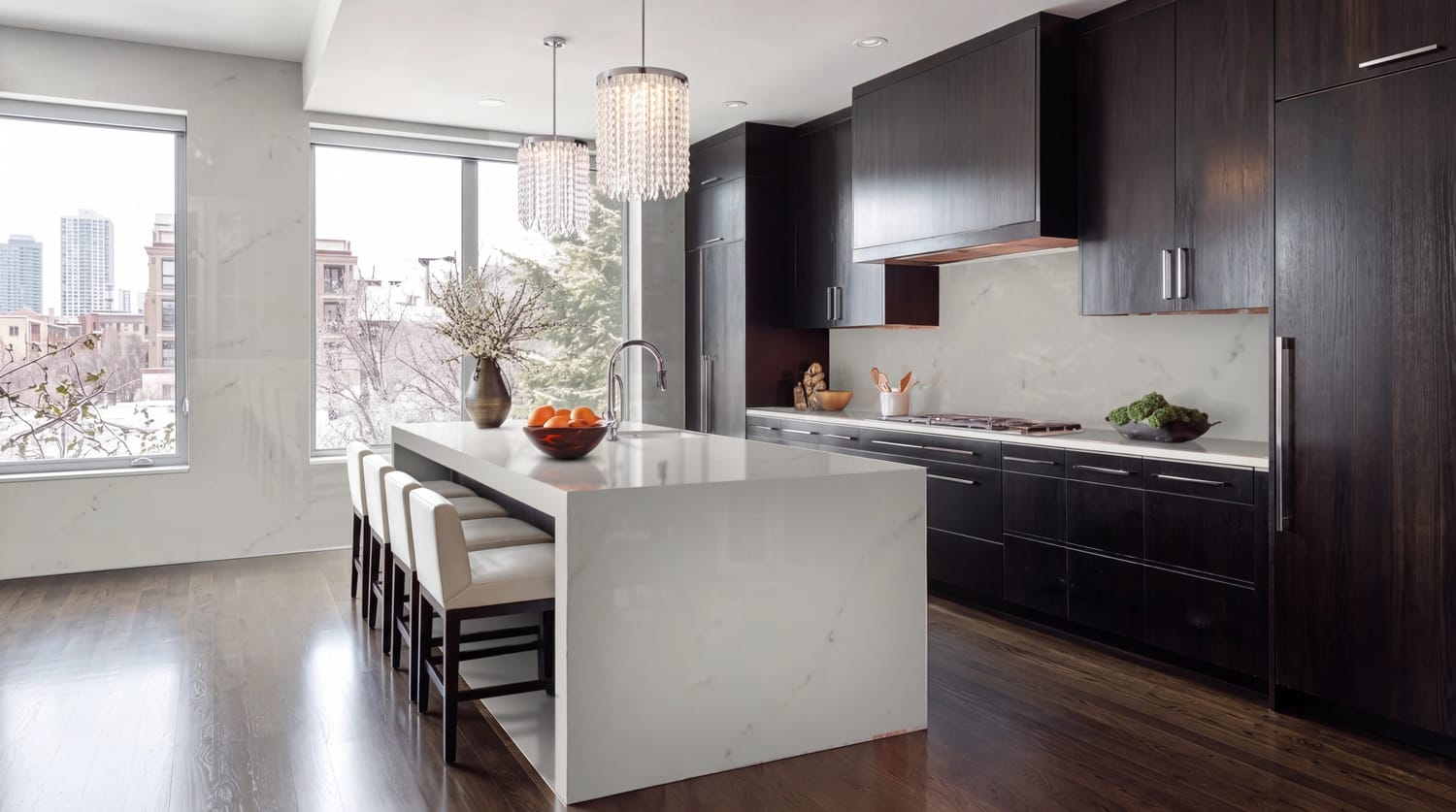
Engineered Quartz Slabs- Sizes, Applications and Selection Guide
Engineered quartz slabs have become a widely specified surface material for contemporary kitchens, bathrooms, hospitality interiors, commercial spaces and architectural projects. Unlike natural stone slabs, engineered quartz is manufactured under controlled conditions to provide consistent colour, pattern, thickness and surface performance.
But choosing an engineered quartz slab is about more than selecting a colour from a catalogue.
Slab size, thickness, finish, pattern direction, application, fabrication requirements, usable area and project scale all influence which quartz surface is right for a project.
This guide explains engineered quartz slab sizes, common thicknesses, applications, selection criteria and the key questions architects, interior designers, fabricators, developers and homeowners should consider before specifying quartz.
Quick Answer: What Is an Engineered Quartz Slab?
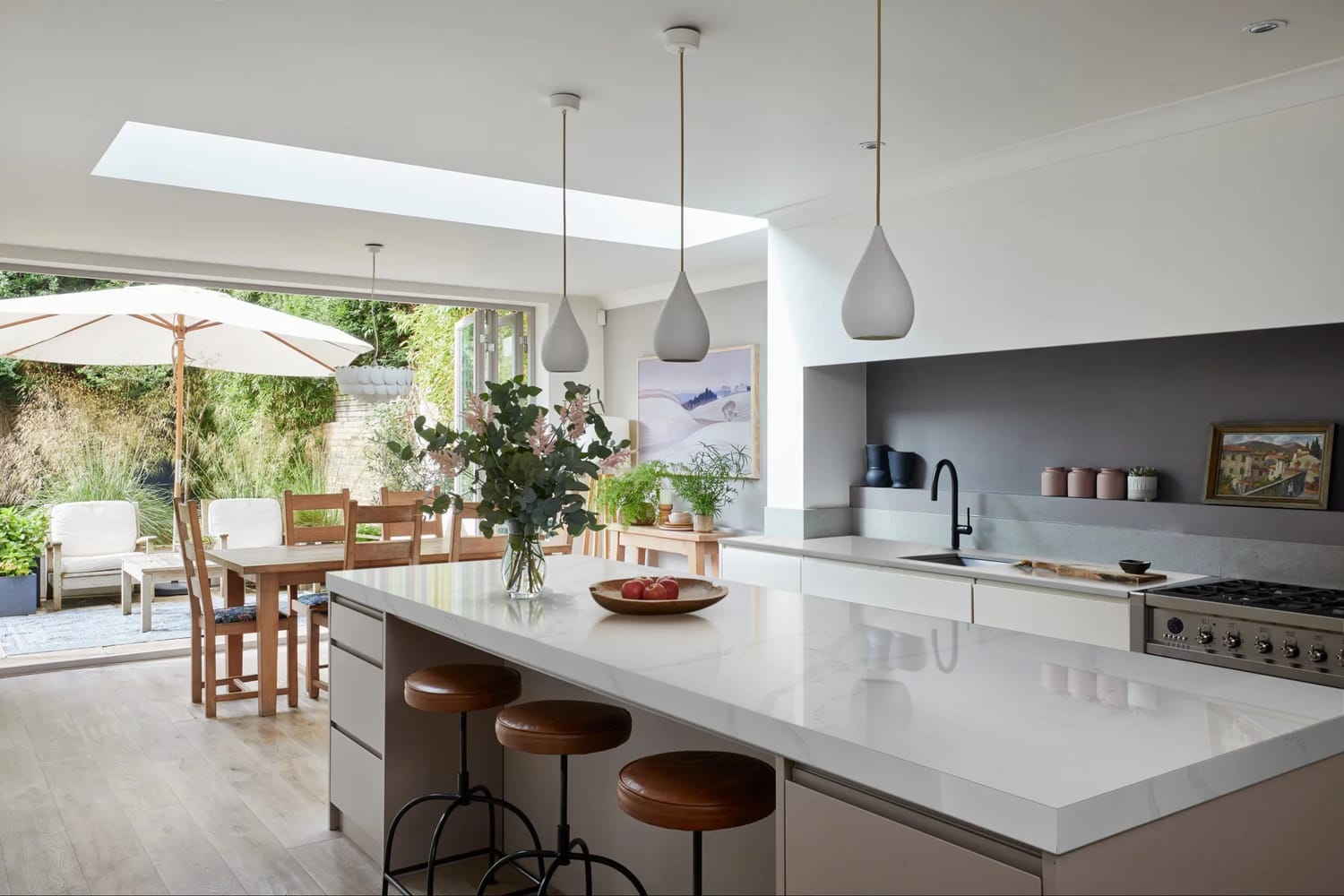
An engineered quartz slab is a manufactured surface material produced using quartz-based mineral content combined with other components and processed into large-format slabs under controlled manufacturing conditions.
Unlike a natural stone slab, where colour and veining are created naturally within quarried stone, engineered quartz allows manufacturers to develop controlled colours, patterns and finishes.
The result is a surface designed for applications such as:
- Kitchen countertops and islands
- Bathroom vanities
- Table and furniture tops
- Wall applications
- Hospitality interiors
- Commercial counters
- Retail interiors
- Residential projects
- Architectural and interior design projects
The exact composition, dimensions, thickness, finish and technical characteristics vary between manufacturers and collections, so project specifications should always be checked against the manufacturer's technical documentation.
Why Does Engineered Quartz Slab Size Matter?
Slab dimensions directly affect how a surface can be designed, fabricated and installed.
A larger slab can provide more usable surface area and may help reduce the number of visible joints in large applications. This can be particularly important for kitchen islands, long countertops, large vanities, reception counters and feature surfaces.
However, the largest slab is not automatically the best slab for every project.
The correct size depends on:
- Finished dimensions of the application
- Number and position of cut-outs
- Pattern and vein direction
- Required edge details
- Installation access
- Fabrication requirements
- Material handling
- Expected wastage
- Number of slabs required
- Availability of the selected design
For this reason, architects and fabricators should evaluate the finished layout before deciding which slab format to specify.
Common Engineered Quartz Slab Sizes
Quartz manufacturers offer different slab formats depending on their manufacturing capabilities and product collections.
Common market formats include standard, jumbo and larger-format slabs. For example, current industry offerings commonly include formats around 3000 × 1400 mm and 3300 × 1650 mm, while some premium manufacturers offer even larger formats. Exact availability varies by manufacturer and collection.
| Slab Format | Typical Market Range | Suitable Applications |
|---|---|---|
| Standard format | Around 3000 × 1400 mm | Countertops, vanities, smaller applications |
| Jumbo format | Around 3300 × 1650 mm | Kitchen islands, large countertops, commercial interiors |
| Super-jumbo / large format | Larger than conventional jumbo | Large islands, feature walls and high-end architectural applications |
These dimensions should be treated as industry examples rather than universal standards. Before ordering, always confirm the exact dimensions available for the Artizia collection being specified.
Artizia focuses on Jumbo Quartz Slabs for luxury residential, hospitality and commercial applications, with its manufacturing and project capabilities designed around architects, designers, fabricators and project developers.
What Quartz Slab Thickness Should You Choose?
Thickness is another important consideration when selecting an engineered quartz surface.
Common engineered quartz thicknesses include 20 mm and 30 mm, while some manufacturers and applications may offer thinner formats. Current market offerings show 20 mm and 30 mm as common specifications for countertops and larger applications.
20 mm Quartz Slabs
20 mm slabs are widely used for:
- Kitchen countertops
- Bathroom vanities
- Table tops
- Commercial counters
- Residential applications
They provide a balance between material weight, appearance and fabrication requirements.
30 mm Quartz Slabs
30 mm quartz can be considered where the design calls for a visually substantial edge or where the project specification requires greater thickness.
Applications can include:
- Premium kitchen islands
- High-end countertops
- Commercial counters
- Feature furniture
- Selected architectural applications
The correct thickness should always be determined by the application, support structure, fabrication method and manufacturer's technical recommendations.
How to Choose the Right Quartz Slab Size for a Kitchen
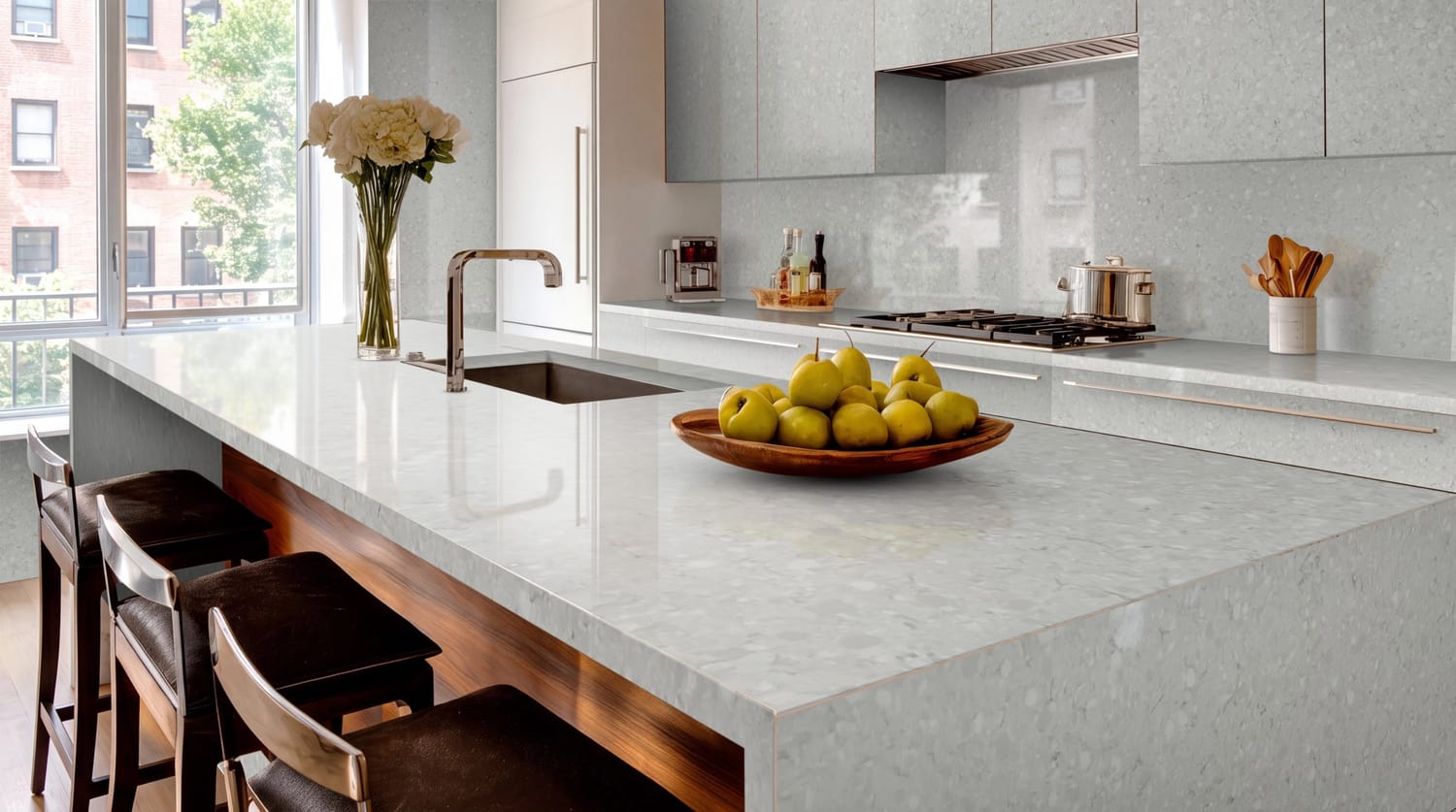
Kitchen countertops are one of the most common applications for engineered quartz.
When selecting a slab for a kitchen, don't look only at the countertop's total square footage. Consider the complete cutting layout.
For example, a kitchen island may require:
- Main countertop area
- Sink cut-out
- Hob cut-out
- Edge allowance
- Waterfall panels
- Backsplash
- Vein alignment
- Additional support or fabrication requirements
A larger jumbo quartz slab can sometimes allow a designer to create a cleaner layout with fewer joints, depending on the island dimensions and cutting plan.
Before ordering quartz for a kitchen, check:
1. Island dimensions
Large islands may require jumbo or larger-format slabs.
2. Sink and hob positions
Cut-outs influence usable slab area.
3. Waterfall edges
Waterfall designs can significantly increase material requirements.
4. Vein direction
Calacatta and marble-look quartz often require careful planning so that the pattern works with the design.
5. Number of slabs
The most economical cutting layout is not always the simplest layout.
Engineered Quartz for Bathroom Vanities
Bathrooms often require smaller finished pieces than kitchens, but material selection is still important.
Engineered quartz slabs can be used for:
- Vanity tops
- Double vanity counters
- Backsplashes
- Wall applications
- Shower-area surfaces where the specific product is suitable
- Decorative panels
- Hospitality bathroom applications
For repeated bathroom units in hotels, residential developments or commercial projects, consistency becomes particularly important.
When hundreds of similar vanities are being fabricated, designers and procurement teams should consider:
- Slab-to-slab colour consistency
- Pattern consistency
- Thickness consistency
- Availability across batches
- Fabrication yield
- Future replacement requirements
This is one reason engineered surfaces can be attractive for larger projects where repeatability matters.
Engineered Quartz for Commercial and Hospitality Projects
Quartz slabs are also used in environments where design consistency and coordinated material selection are important.
Applications can include:
Hotels
- Reception counters
- Bathroom vanities
- Bar counters
- Restaurant counters
- Guest-room surfaces
- Feature surfaces
Offices
- Reception desks
- Pantry counters
- Meeting-room tables
- Breakout areas
- Feature counters
Retail
- Display counters
- Cash desks
- Product display surfaces
- Wall applications
Residential Developments
- Kitchen countertops
- Bathroom vanities
- Utility areas
- Common-area surfaces
For large projects, slab selection should happen alongside procurement and fabrication planning rather than after the interior design has already been finalized.
How to Select Quartz Slabs for a Large Project
Large projects require a different approach from a single residential kitchen.
For a project involving multiple apartments, hotel rooms, villas, offices or commercial spaces, the specification should consider the entire supply chain.
1. Confirm slab dimensions
Make sure the selected manufacturer can consistently supply the required format.
2. Confirm thickness
Specify the required thickness at the beginning of the project.
3. Check batch consistency
Large projects may be supplied in multiple batches. Ask how the manufacturer manages colour and pattern consistency between batches.
4. Evaluate the complete design
For heavily veined surfaces, examine the full slab rather than relying only on a small sample.
5. Plan fabrication
The cutting plan should be developed before final slab quantities are ordered.
6. Consider future requirements
For phased developments, maintain accurate information about the selected collection, colour, finish and production batch wherever possible.
7. Confirm packaging and logistics
Large-format slabs require appropriate handling, packing and transportation to reduce the risk of damage.
How Should You Choose the Design of an Engineered Quartz Slab?
Size and thickness are only part of the selection process.
The visual character of the surface can have a major influence on the final interior.
Solid and Minimal Quartz
Suitable for:
- Contemporary kitchens
- Minimal interiors
- Commercial counters
- Clean architectural spaces
Fine-Veined Quartz
Fine veining can provide a natural-stone-inspired appearance without becoming the dominant element of the interior.
Bold-Veined Quartz
Bold patterns can become the visual centre of:
- Kitchen islands
- Reception counters
- Feature walls
- Luxury bathrooms
- Hospitality interiors
Calacatta-Inspired Quartz
Calacatta-style engineered quartz is particularly relevant for luxury interiors because it combines a light base with expressive veining.
When specifying Calacatta quartz, don't evaluate only the colour name.
Look at:
- Vein scale
- Vein direction
- Base colour
- Pattern movement
- Full-slab appearance
- Book-matching potential
- Consistency between slabs
A small sample cannot always communicate the complete character of a large-format veined slab.
Polished, Matte or Textured Quartz: Which Finish Should You Choose?
Surface finish changes how a quartz slab interacts with light and the surrounding interior.
Polished Finish
A polished surface creates a reflective appearance and can emphasize colour, pattern and veining.
It is frequently considered for:
- Kitchen countertops
- Luxury residential interiors
- Reception areas
- Feature surfaces
Matte Finish
A matte finish provides a softer, more understated appearance and can work well with contemporary and minimalist design concepts.
Textured or Leather-Type Finishes
Where available, textured finishes can introduce additional tactile character to a surface.
The availability of finishes varies by manufacturer and collection, so designers should confirm the technical specification before finalizing a project.
What Makes a Premium Engineered Quartz Slab?
A premium quartz surface is not defined by appearance alone.
For architects, designers, fabricators and project buyers, the manufacturing and supply process is equally important.
Important factors include:
Consistent dimensions
Slabs should meet the manufacturer's specified dimensional tolerances.
Consistent thickness
Consistent thickness supports predictable fabrication and installation.
Surface quality
The finished surface should meet the manufacturer's quality requirements for the selected finish.
Pattern consistency
This is particularly important for marble-look and Calacatta quartz designs.
Quality control
Manufacturers should have defined processes for raw material selection, production, finishing and inspection.
Reliable supply
For commercial and hospitality projects, availability and repeatability can be as important as the initial design selection.
Artizia's manufacturing positioning combines advanced technology with quality inspection and precision processing, with its current website highlighting Breton Stone Technology and Jumbo Quartz Slabs for residential, hospitality and commercial applications.
Engineered Quartz Slabs vs Natural Stone Slabs
The choice between engineered quartz and natural stone depends on the project's design requirements, technical requirements, budget and desired material character.
| Factor | Engineered Quartz | Natural Stone |
|---|---|---|
| Manufacturing | Controlled manufacturing | Quarried from natural deposits |
| Pattern | Designed and controlled | Naturally formed |
| Colour consistency | Generally more controlled | Natural variation |
| Design range | Broad range of engineered designs | Dependent on quarry/material |
| Maintenance | Generally low maintenance | Depends on stone type and finish |
| Slab planning | Predictable formats | Varies by stone and quarry |
| Project consistency | Useful for repeated specifications | Natural variation can occur |
Neither material should be selected solely on appearance. The final decision should consider application, technical requirements, maintenance expectations, fabrication and design intent.
What Should Architects Check Before Specifying Quartz?
Architects and interior designers can use this checklist before finalizing an engineered quartz surface:
Material
- What is the product specification?
- What is the intended application?
- Is the surface suitable for the project environment?
Slab
- What is the exact slab size?
- What thicknesses are available?
- What finishes are available?
- Is the complete slab available for inspection?
Design
- How does the vein move across the slab?
- Can the required pattern be achieved after cutting?
- Is book-matching required?
Fabrication
- What cutting method is recommended?
- Are there special fabrication requirements?
- What edge profiles are possible?
Supply
- Is the colour currently available?
- Can additional slabs be supplied later?
- How is batch consistency managed?
- How are slabs packaged and transported?
Documentation
- Is technical documentation available?
- Are relevant certifications available?
- What warranty applies to the product?
This process can reduce specification problems later in the project.
Why Slab Yield Matters for Quartz Projects
Slab yield refers to how efficiently the required finished pieces can be obtained from the available slab.
Better slab planning can help:
- Reduce unnecessary material waste
- Control project costs
- Minimize joints
- Improve vein alignment
- Plan fabrication more efficiently
- Determine the correct number of slabs
This is particularly important when using premium Calacatta or heavily veined quartz, where pattern orientation can be as important as raw square footage.
Choosing a Quartz Manufacturer or Supplier in India
If you're sourcing engineered quartz slabs in India, don't compare suppliers based only on price.
Evaluate the manufacturer or supplier across several factors:
- Manufacturing capability
- Slab formats
- Thickness options
- Design collection
- Surface finishes
- Quality-control process
- Batch consistency
- Project support
- Fabricator support
- Packaging and logistics
- Technical documentation
- Warranty
- Export capability
- Long-term availability
For architects and project developers, a manufacturer that can support the project from sample selection through slab supply can provide greater predictability than simply choosing the lowest quoted price.
Why Jumbo Quartz Slabs Are Important for Modern Architecture
Modern interiors increasingly use large islands, long counters, feature walls and visually continuous surfaces.
Jumbo quartz slabs can provide designers with greater layout flexibility for these applications.
They are particularly relevant for:
- Large kitchen islands
- Waterfall countertops
- Long commercial counters
- Hospitality reception desks
- Feature walls
- Large bathroom vanities
- Premium residential interiors
However, large slabs also require proper transportation, handling, fabrication and installation planning. Slab dimensions should therefore be considered together with the physical access and fabrication capabilities available at the project location.
Artizia Engineered Quartz Slabs
Artizia is a premium engineered quartz surface brand from the house of Marudhar, manufactured in Jaipur, India.
The brand currently offers Jumbo Quartz Slabs for luxury residential, hospitality and commercial projects and works with architects, interior designers, fabricators, distributors and project developers across India and international markets.
Artizia's current manufacturing positioning highlights Breton Stone Technology, controlled production, precision finishing and quality inspection, with collections ranging from clean white surfaces to contemporary veined designs.
For projects where design, consistency and surface performance need to work together, selecting the slab should be treated as part of the architectural specification rather than simply a final material purchase.
Frequently Asked Questions About Engineered Quartz Slabs
What is the standard size of an engineered quartz slab?
There is no single universal quartz slab size. Common market formats include approximately 3000 × 1400 mm and 3200 × 1600 mm, while some manufacturers offer larger formats. Always confirm the exact dimensions available for the selected collection.
What thickness is best for quartz countertops?
20 mm and 30 mm are common thicknesses for quartz countertop applications. The appropriate thickness depends on the design, support structure, fabrication method and manufacturer's technical specification.
Are jumbo quartz slabs better than standard slabs?
Not necessarily. Jumbo slabs provide more surface area and can be advantageous for large islands, long counters and feature surfaces, but the correct format depends on the project's dimensions, cutting plan, handling requirements and design.
Can engineered quartz be used for kitchen countertops?
Yes. Engineered quartz is widely used for kitchen countertops and islands. The specific product should be selected according to the manufacturer's technical recommendations and intended application.
Can engineered quartz be used in bathrooms?
Yes. Engineered quartz is commonly used for bathroom vanity tops and other interior surface applications, subject to the product's technical specification.
Is Calacatta quartz suitable for large projects?
Calacatta-style quartz can be particularly effective in large residential, hospitality and commercial interiors. For large projects, designers should evaluate the full slab, vein direction, batch consistency and required number of slabs before final specification.
How do I choose the right quartz slab for a project?
Start with the application and finished dimensions. Then evaluate slab size, thickness, design, vein direction, finish, fabrication requirements, technical specifications, availability and project supply requirements.
What should I ask a quartz manufacturer before ordering?
Ask about slab dimensions, thickness, available finishes, technical specifications, quality control, batch consistency, warranty, certifications, project support, packaging, lead times and future availability.
Final Thoughts
Choosing an engineered quartz slab is not simply about finding an attractive colour.
The best specification considers the slab format, thickness, application, design, pattern direction, fabrication, project scale, quality requirements and long-term supply together.
For a residential kitchen, the focus may be on slab size, design and fabrication. For a hotel, commercial development or large architectural project, consistency, procurement, batch control and supply capability become equally important.
Whether you are an architect specifying materials, an interior designer developing a luxury space, a fabricator planning a cutting layout, a developer sourcing surfaces or a homeowner selecting a kitchen countertop, understanding these factors can help you choose an engineered quartz surface with greater confidence.
Artizia brings together engineered quartz surfaces, Jumbo slab formats, manufacturing expertise and a design-led collection for contemporary residential, hospitality and commercial projects.
Explore Artizia's engineered quartz collection or request a sample to evaluate the surface, colour and full-slab character for your project.