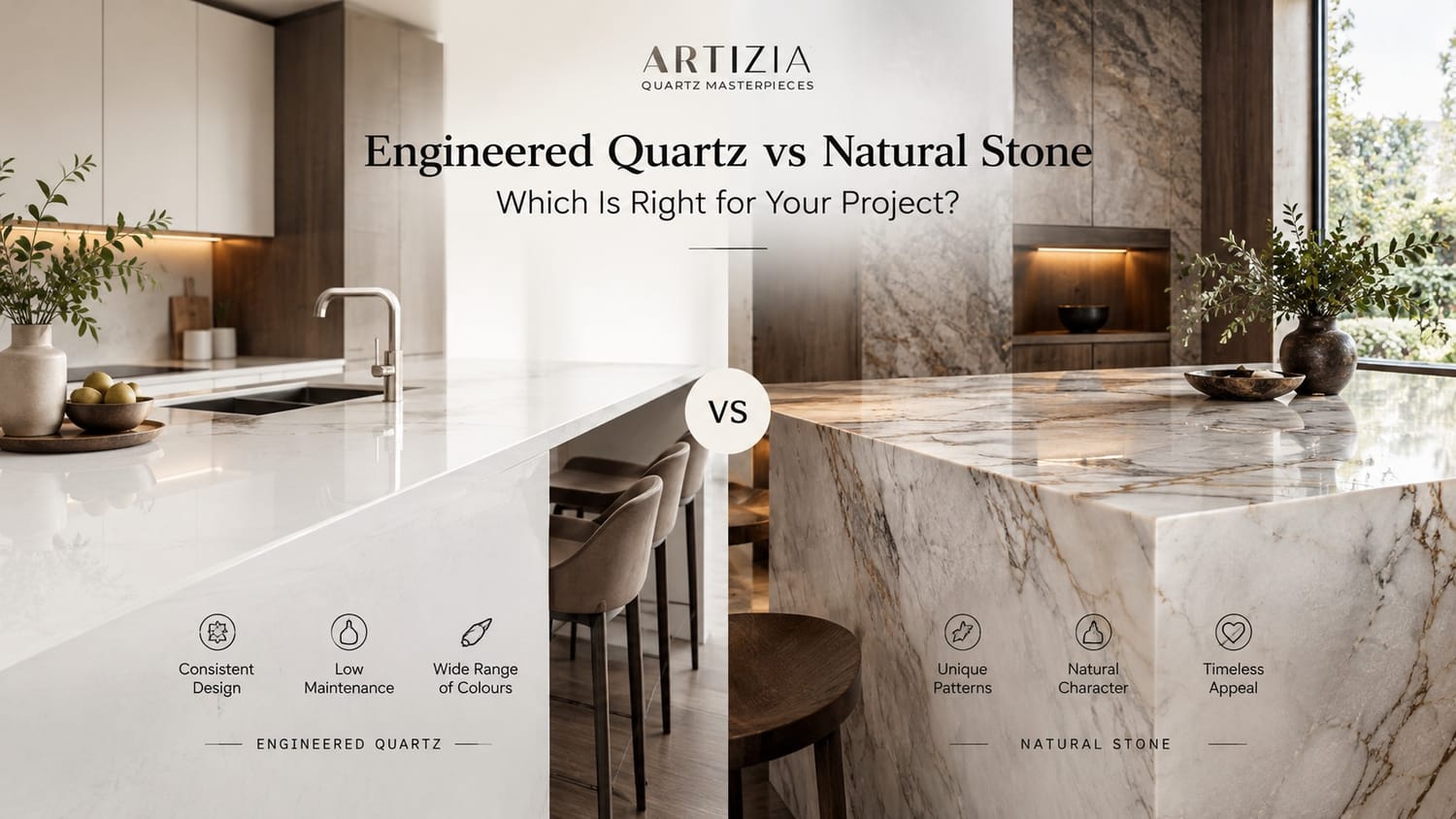
Engineered Quartz vs Natural Stone: Which Is Right for Your Project?
When selecting a surface for a kitchen, bathroom, hotel, commercial space or architectural project, the material you choose has a direct impact on the appearance, performance and maintenance of the space.
Two of the most widely considered options are engineered quartz and natural stone.
Both materials offer premium aesthetics and can create beautiful, long-lasting interiors. However, they are fundamentally different. Natural stone is quarried from the earth, while engineered quartz is manufactured under controlled conditions to achieve specific performance and design characteristics.
So, which one is better?
The answer depends on your project's requirements.
If you value natural variation, geological character and individuality, natural stone can be an excellent choice. If you are looking for consistent design, low maintenance, predictable performance and contemporary surface options, engineered quartz can offer significant advantages.
In this guide, we compare engineered quartz vs natural stone across appearance, durability, maintenance, consistency, applications, design flexibility and project requirements to help you make the right decision.
Engineered Quartz vs Natural Stone: At a Glance
| Factor | Engineered Quartz | Natural Stone |
|---|---|---|
| Origin | Manufactured surface | Quarried from natural deposits |
| Appearance | Controlled and consistent designs | Unique natural patterns and variation |
| Maintenance | Generally low maintenance | Depends on stone type; some require sealing |
| Stain resistance | High, depending on product | Varies by stone and treatment |
| Design consistency | High | Naturally variable |
| Colour selection | Wide range of engineered designs | Determined by natural availability |
| Large projects | Excellent for consistent specifications | Requires careful slab selection |
| Uniqueness | Controlled appearance | Every slab can be different |
| Fabrication | Predictable material characteristics | Characteristics vary by stone |
| Best suited for | Modern residential, commercial and hospitality interiors | Projects prioritising natural character and individuality |
The important point is that neither material is universally "better." The right choice depends on how the surface needs to perform and what the design intends to achieve.
What Is Engineered Quartz?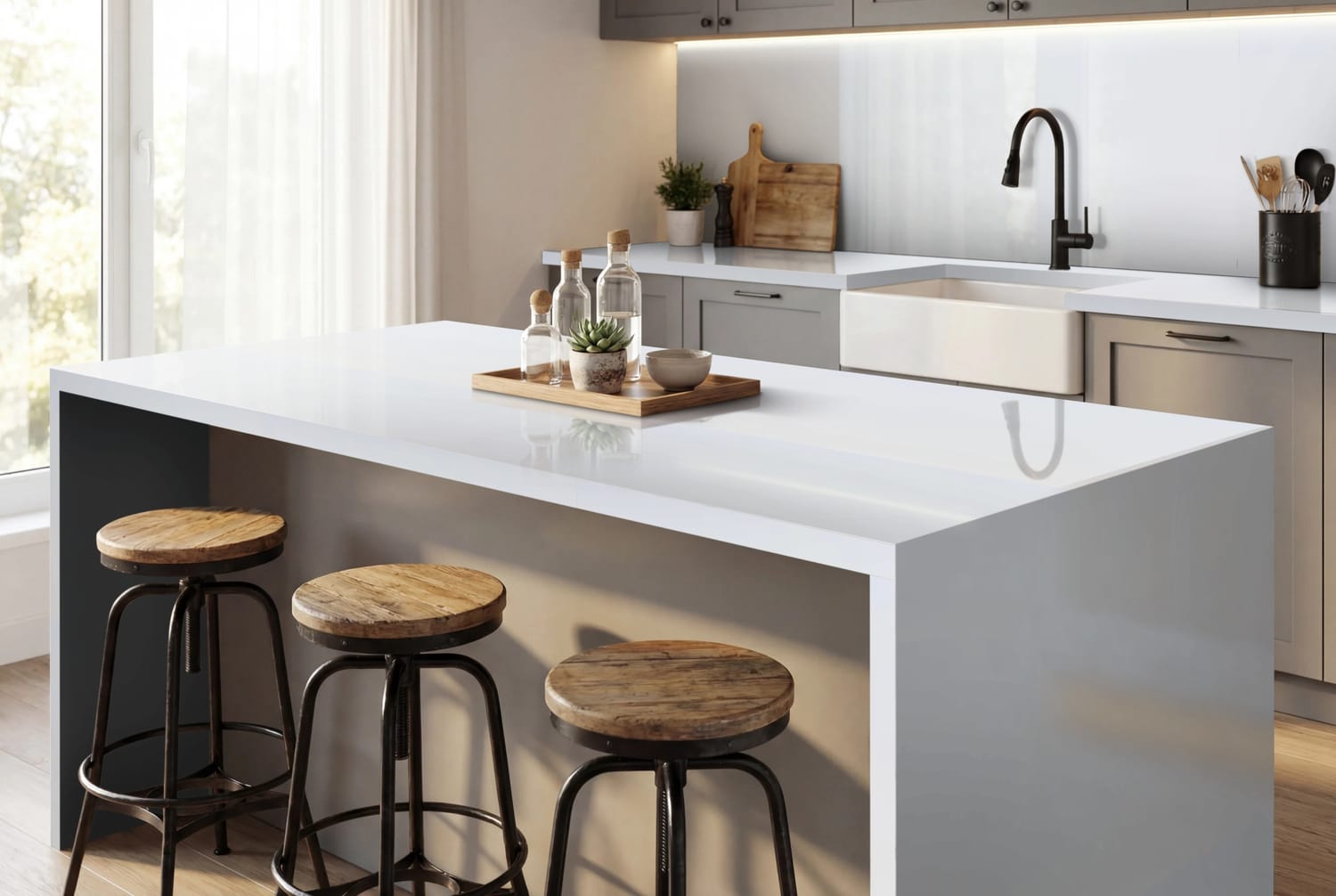
Engineered quartz is a manufactured surface created using quartz-based mineral content combined with binding materials, pigments and other components.
The material is processed under controlled manufacturing conditions and formed into slabs with carefully developed colours, patterns and finishes.
Unlike natural stone, where the final appearance is determined by geological formation, engineered quartz allows manufacturers to develop specific aesthetic and technical characteristics.
Modern engineered quartz surfaces can feature:
- Solid colours
- Subtle patterns
- Marble-inspired veining
- Calacatta-inspired designs
- Contemporary textures
- Large-format slabs
- Different surface finishes
This design flexibility has made engineered quartz increasingly popular among architects, interior designers, fabricators and project developers.
What Is Natural Stone?
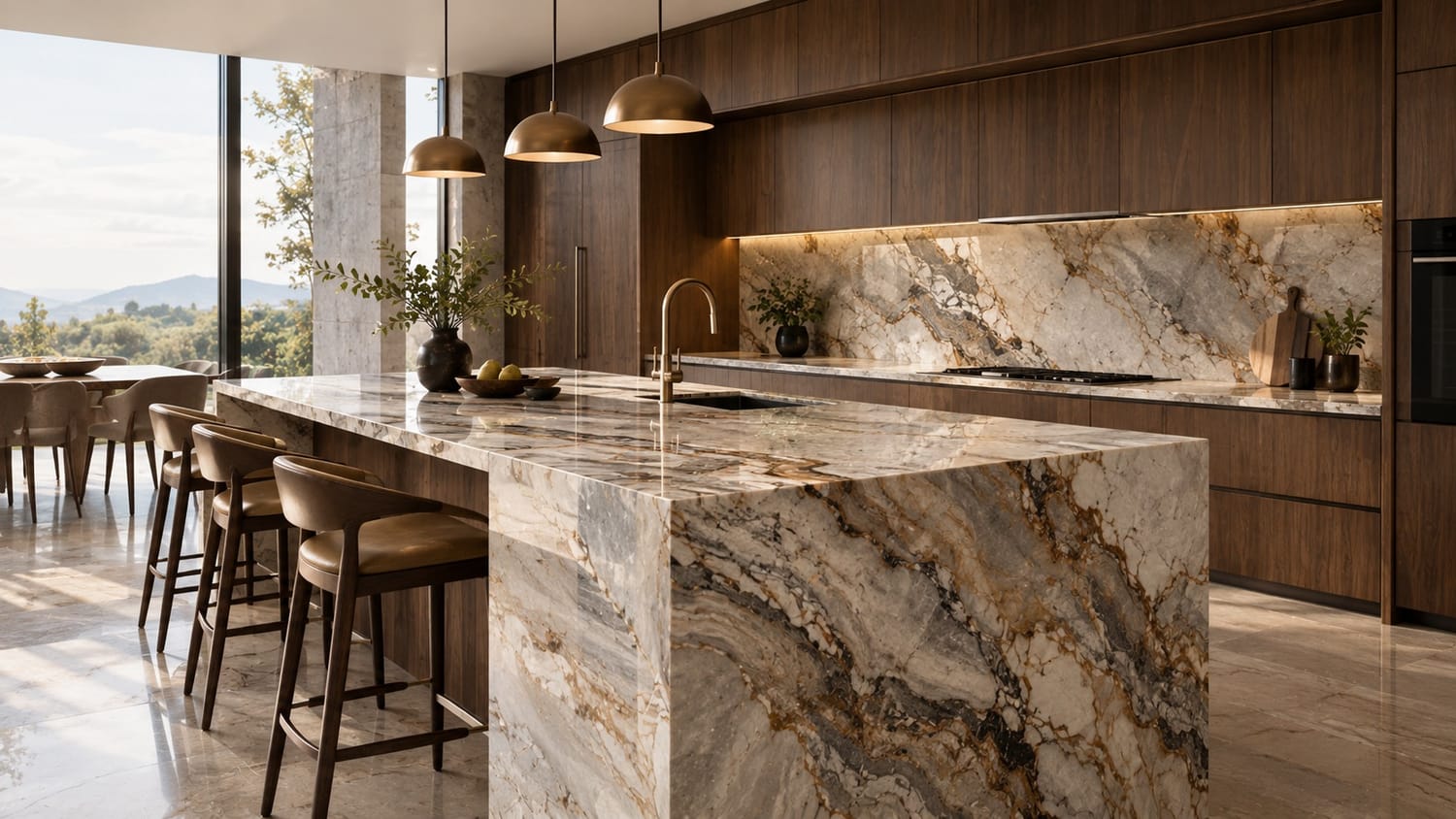
Natural stone is a geological material extracted from quarries and processed into slabs for architectural and interior applications.
Common natural stones include:
- Marble
- Granite
- Quartzite
- Limestone
- Travertine
- Sandstone
Each stone develops naturally over geological periods, which means its colour, mineral composition, veining and pattern can vary from one slab to another.
This natural variation is one of the biggest reasons architects and designers choose natural stone.
A natural marble slab, for example, may contain unique veins and mineral movements that cannot be reproduced exactly in another slab.
For projects where individuality and natural character are central to the design concept, this can be a major advantage.
1. Appearance: Engineered Quartz vs Natural Stone
Appearance is often the first consideration when selecting a surface.
Natural Stone
Natural stone offers something that is difficult to replicate: natural variation.
Every slab can have differences in:
- Veining
- Colour
- Mineral movement
- Texture
- Pattern
- Tonal variation
This makes natural stone particularly attractive for statement interiors, luxury residences and spaces where the material itself is intended to become a visual feature.
Engineered Quartz
Engineered quartz takes a different approach.
Instead of relying entirely on naturally occurring patterns, manufacturers can develop controlled designs inspired by marble, stone and contemporary architectural aesthetics.
This can provide greater consistency between slabs.
For example, if a large project requires multiple slabs with a similar visual character, engineered quartz can make planning and specification easier.
Best choice:
- Choose natural stone for authentic geological character and individuality.
- Choose engineered quartz for controlled design and visual consistency.
2. Durability and Everyday Performance
Both engineered quartz and many natural stones can provide excellent durability when the correct material is selected and properly fabricated and installed.
However, their performance characteristics are different.
Natural stone performance varies considerably depending on the specific stone. Granite, marble and quartzite, for example, should not be treated as identical materials.
Engineered quartz is manufactured to provide more controlled material characteristics across the slab.
For high-use interior surfaces, this predictability can be particularly valuable.
That is why architects and project teams often evaluate not just the appearance of a surface but also:
- Scratch resistance
- Impact resistance
- Stain resistance
- Water absorption
- Surface hardness
- Fabrication behaviour
- Long-term maintenance requirements
The specific technical performance should always be verified through the manufacturer's technical documentation rather than assuming that every quartz or natural stone product performs identically.
3. Maintenance: Which Is Easier to Maintain?
Maintenance is one of the biggest practical differences between engineered quartz and natural stone.
Many natural stones can require periodic sealing depending on the stone's porosity, finish and application. Marble can also be susceptible to etching from acidic substances, which is an important consideration in kitchens and other high-use environments.
Engineered quartz is generally designed as a low-maintenance surface and typically does not require periodic sealing.
For everyday interiors, this can make quartz particularly attractive for:
- Kitchen countertops
- Bathroom vanities
- Hospitality spaces
- Offices
- Retail environments
- High-use residential interiors
However, "low maintenance" does not mean "maintenance free." The manufacturer's cleaning and care recommendations should always be followed.
If maintenance is a major priority:
Engineered quartz generally has the advantage.
4. Stain Resistance and Porosity
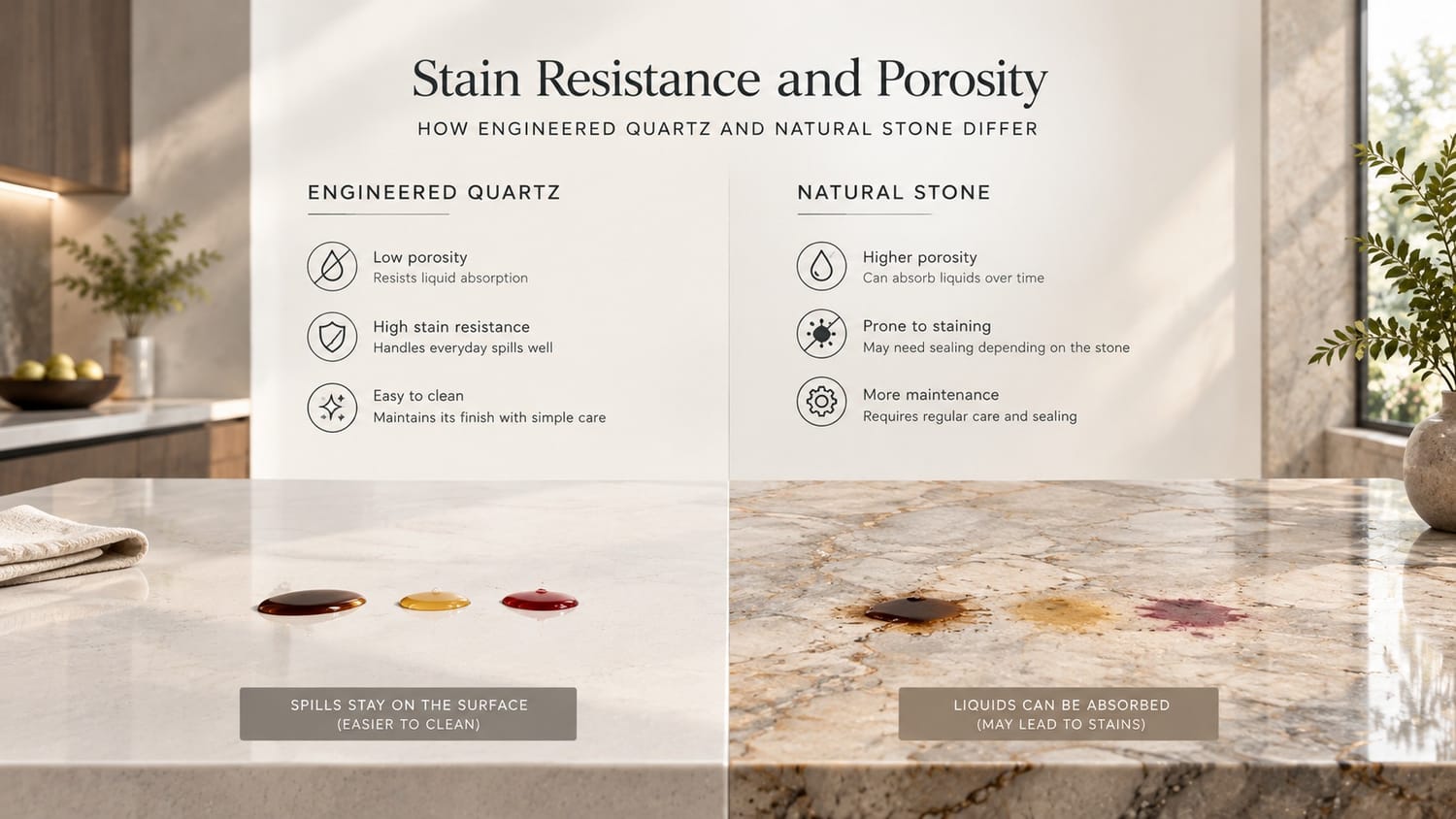
Porosity is another important consideration.
Different natural stones have different levels of porosity, so their resistance to liquids and stains can vary.
Proper sealing can improve the stain resistance of many natural stones, but the sealing requirement depends on the material and application.
Engineered quartz is generally manufactured with a low-porosity surface, making it well suited to applications where resistance to everyday spills is important.
For kitchens and bathrooms, this characteristic can make engineered quartz a practical option.
Coffee, oil, sauces and other common household substances are exactly the type of everyday exposure that should be considered when selecting a countertop material.
5. Design Consistency
This is where engineered quartz can have a significant advantage for large projects.
Imagine a hotel project requiring dozens of vanity tops across multiple floors.
The design team may want the surfaces to maintain a consistent visual identity throughout the property.
With natural stone, variation between slabs is expected because each slab comes from a natural geological formation.
With engineered quartz, manufacturers can develop controlled patterns and colours, allowing project teams to plan a more consistent material palette.
This makes engineered quartz particularly useful for:
- Hotels
- Restaurants
- Residential developments
- Office projects
- Retail spaces
- Large-scale architectural projects
Natural variation can be beautiful, but when consistency is the priority, engineered surfaces can provide greater control.
6. Color and Design Selection
Natural stone colors are ultimately determined by geological availability.
That is part of its appeal, but it can also limit the level of design control.
Engineered quartz gives manufacturers much greater flexibility in developing surface designs.
Today, engineered quartz collections can include:
- Pure whites
- Warm neutrals
- Grey surfaces
- Dramatic veining
- Calacatta-inspired designs
- Marble-inspired surfaces
- Minimal contemporary patterns
- Bold architectural designs
This allows architects and designers to select a surface based on the overall interior concept rather than being limited only to what is currently available from a quarry.
7. Calacatta Quartz vs Natural Marble
One of the most interesting comparisons is Calacatta-inspired engineered quartz vs natural marble.
Natural Calacatta marble is valued for its distinctive appearance, dramatic veining and luxurious character.
Engineered quartz can take inspiration from this aesthetic while providing a more controlled and consistent surface design.
For an architect or designer, the choice comes down to priorities.
Choose natural marble when:
- Natural variation is part of the design
- Authentic natural stone is important
- Each slab can be selected individually
- The project accepts a higher level of material variation
- The design intentionally celebrates natural stone
Consider Calacatta-inspired engineered quartz when:
- A consistent appearance is important
- Low maintenance is a priority
- Multiple slabs are required
- The project requires predictable design coordination
- A marble-inspired aesthetic is desired with engineered surface characteristics
The two materials should not be viewed as identical. Instead, they offer two different ways to achieve a premium visual language.
8. Engineered Quartz vs Natural Stone for Kitchens
The kitchen is one of the most demanding applications for any surface.
The countertop can be exposed to:
- Food
- Oils
- Water
- Spills
- Cleaning products
- Scratching
- Heat
- Heavy everyday use
Engineered quartz is popular for kitchens because of its low-porosity characteristics, design consistency and relatively simple maintenance.
Natural stone can also be an excellent kitchen material, particularly granite and certain quartzites, but the specific stone should be evaluated for its maintenance and performance requirements.
One important consideration with engineered quartz is heat. Because many engineered quartz products contain resin-based binders, manufacturers typically recommend protecting the surface from direct high heat and using trivets or heat protection.
Therefore, material selection should consider not only appearance but also how the kitchen will actually be used.
9. Engineered Quartz vs Natural Stone for Bathrooms
Bathrooms require surfaces that can handle:
- Moisture
- Water exposure
- Cleaning
- Cosmetics
- Personal-care products
- Frequent everyday use
Engineered quartz can be an excellent option for bathroom vanities and related interior surfaces because of its low-porosity characteristics and easy-care requirements.
Natural stone can also create exceptionally luxurious bathrooms, particularly when marble or other decorative stones are used.
However, the maintenance requirements of the selected stone should be considered before specification.
For a project where ease of maintenance is a major priority, engineered quartz may offer a practical advantage.
10. What About Commercial and Hospitality Projects?
Large commercial and hospitality projects introduce another important factor: repeatability.
A residential project might require only a few slabs.
A hotel, however, could require hundreds of vanity tops, countertops or other surface elements.
In such projects, architects and procurement teams often need:
- Consistent colour
- Consistent surface appearance
- Reliable slab availability
- Predictable fabrication
- Technical documentation
- Packaging suitable for transportation
- Project-level support
- Repeat supply
Engineered quartz can be particularly suitable for these requirements because its manufacturing process allows greater control over design and product specifications.
Natural stone can still be the right choice for luxury hospitality projects where unique stone selection and natural character are part of the design concept.
11. Large Slabs and Project Planning
Large-format and Jumbo quartz slabs can offer another advantage when planning contemporary interiors.
Larger slabs can help designers achieve:
- Fewer joints
- Cleaner visual lines
- Large kitchen islands
- Statement walls
- Continuous surfaces
- More dramatic design compositions
However, slab size alone should not determine the material choice.
Architects and fabricators should also consider:
- Slab dimensions
- Thickness
- Weight
- Handling requirements
- Cutting plans
- Vein direction
- Book-matching requirements
- Edge details
- Installation conditions
For large projects, these factors should be considered during the design stage rather than after the material has been selected.
12. Sustainability and Material Selection
Sustainability is becoming increasingly important in architectural material selection.
However, there is no simple rule that says engineered quartz is always more sustainable than natural stone, or vice versa.
The environmental impact can depend on several factors, including:
- Raw material sourcing
- Quarrying
- Manufacturing processes
- Transportation
- Processing
- Product lifespan
- Maintenance
- Waste during fabrication
- End-of-life considerations
For a responsible project specification, it is better to evaluate the manufacturer's documented environmental information rather than relying on broad material claims.
Architects can also ask manufacturers about available environmental certifications, product documentation and manufacturing practices.
13. Cost: Look Beyond the Initial Price
Price is an important part of any project, but the cheapest slab is not necessarily the most economical option over the life of the project.
When comparing engineered quartz and natural stone, consider the complete cost:
Material + fabrication + installation + maintenance + wastage + replacement risk
For example, a natural stone may have an attractive initial price but require additional maintenance depending on its characteristics.
Similarly, an engineered quartz surface may have a higher initial material cost but provide predictable performance and lower maintenance requirements.
For commercial projects especially, lifecycle value can be more meaningful than simply comparing the price per square foot.
14. Engineered Quartz vs Natural Stone: Which Should Architects Choose?
Architects should begin with the project's requirements rather than starting with a specific material.
Ask:
1. Is design consistency important?
If yes, engineered quartz may be the better fit.
2. Is natural variation part of the design?
If yes, natural stone may be preferable.
3. How much maintenance can the project accommodate?
If minimal maintenance is important, engineered quartz has an advantage in many interior applications.
4. Is the project large or repetitive?
For large developments and hospitality projects, engineered quartz can simplify consistency and material planning.
5. Is the surface exposed to significant heat or outdoor conditions?
The specific product must be checked against the manufacturer's technical recommendations. Some natural stones may be better suited to high-heat or outdoor applications, while many engineered quartz products are intended primarily for interior use.
6. Does the project require a unique slab?
Natural stone may be the better choice when no two slabs should look exactly alike.
7. Does the project require repeat supply?
Engineered quartz can be advantageous when consistent designs and controlled production are important.
Engineered Quartz vs Natural Stone: Pros and Cons
Engineered Quartz
Advantages
- Consistent appearance
- Wide range of colours and designs
- Low-porosity characteristics
- Generally easy to maintain
- Suitable for many residential applications
- Well suited to large and repetitive projects
- Marble-inspired designs available
- Controlled manufacturing
- Predictable product specifications
Considerations
- Direct high heat should generally be avoided
- Product performance varies by manufacturer
- Not every engineered quartz product is suitable for every application
- Indoor/outdoor suitability must be verified
- Natural variation is intentionally limited
Natural Stone
Advantages
- Authentic natural material
- Unique slab-to-slab variation
- Distinctive veining and mineral movement
- Strong visual character
- Excellent option for statement interiors
- Wide variety of stone types
- Some stones are highly heat resistant
Considerations
- Performance varies significantly between stone types
- Some materials require sealing
- Marble can be sensitive to acidic substances
- Natural variation can make matching difficult
- Availability of a specific stone can change
- Large projects may require more detailed slab selection
A Simple Decision Guide
If your priority is:
Low maintenance → Consider engineered quartz
Natural uniqueness → Consider natural stone
Consistent colour and pattern → Consider engineered quartz
Unique veining → Consider natural stone
Large-scale project consistency → Consider engineered quartz
Statement natural material → Consider natural stone
Modern kitchen → Engineered quartz is often a strong option
Luxury natural-stone interior → Marble, granite or quartzite may be appropriate
Hospitality project with repetitive surfaces → Engineered quartz can simplify material consistency
The final decision should always be based on the specific product, application and technical documentation.
Why the Manufacturer Matters
Choosing between engineered quartz and natural stone is only the first step.
For engineered quartz, the manufacturer plays a major role in the final product experience.
Two quartz slabs can look similar in a photograph but differ in:
- Manufacturing technology
- Raw material selection
- Slab dimensions
- Thickness
- Surface finish
- Design consistency
- Quality control
- Packaging
- Technical documentation
- Warranty
- Project support
This is particularly important when specifying quartz for large residential, commercial or hospitality projects.
A reliable manufacturer should be able to provide clear information about product specifications, recommended applications, care requirements and warranty conditions.
Artizia: Engineered Quartz Surfaces for Modern Projects
Artizia is a premium engineered quartz surface brand from the house of Marudhar, developed for architects, interior designers, fabricators and project professionals.
With manufacturing experience and advanced Breton Stone Technology, Artizia focuses on engineered quartz surfaces that combine contemporary design with controlled manufacturing and quality-focused production.
The collection includes modern whites, sophisticated neutrals and marble-inspired surfaces designed for contemporary residential, commercial and hospitality interiors.
Artizia also offers Jumbo quartz slabs, making the collection suitable for projects where large-format surfaces and design continuity are important.
The brand provides a 15-year warranty on its products, subject to the applicable warranty terms and conditions.
From manufacturing and quality inspection to surface finishing and packaging, the focus is on delivering engineered quartz surfaces suitable for demanding architectural applications.
Whether the project requires a subtle white quartz surface, a dramatic Calacatta-inspired design or a large-format statement surface, the right material should ultimately be selected based on the project's design, performance and technical requirements.
Frequently Asked Questions
Is engineered quartz better than natural stone?
Not universally. Engineered quartz can offer advantages in consistency, low maintenance and controlled design, while natural stone provides authentic geological variation and unique character. The right choice depends on the application and project priorities.
Is quartz more durable than marble?
Engineered quartz is generally designed for consistent everyday performance and is highly resistant to many common forms of wear. Marble has excellent longevity but is more susceptible to scratching and acid etching. The exact performance depends on the products being compared.
Does natural stone require more maintenance than quartz?
Some natural stones require periodic sealing and more careful maintenance. Engineered quartz is generally low maintenance and typically does not require sealing. However, care requirements should always be checked for the specific product.
Can engineered quartz look like natural marble?
Yes. Modern engineered quartz collections include marble-inspired and Calacatta-inspired designs with controlled veining and colour patterns.
Is engineered quartz suitable for large projects?
Yes. Its design consistency and availability in large-format slabs can make engineered quartz suitable for residential developments, hotels, commercial spaces and other architectural projects.
Is natural stone better for luxury interiors?
Natural stone can be an excellent choice for luxury interiors because of its authentic character and unique variation. However, premium engineered quartz can also deliver a sophisticated aesthetic with greater design consistency and easier maintenance.
Is engineered quartz suitable for outdoor applications?
Not every engineered quartz product is suitable for outdoor use. Always check the manufacturer's technical documentation and application recommendations before specifying the material outdoors.
What should architects consider before selecting a surface?
Architects should consider appearance, durability, maintenance, slab size, thickness, consistency, fabrication requirements, application suitability, availability, technical documentation and long-term project requirements.
Final Thoughts
The decision between engineered quartz and natural stone is not about choosing the universally superior material.
It is about choosing the material that is right for the project.
Natural stone brings geological history, individuality and natural variation. Engineered quartz brings controlled design, consistent production, low-maintenance characteristics and flexibility for modern architectural applications.
For a unique luxury residence, natural marble or granite may be the perfect choice.
For a modern kitchen, engineered quartz may provide the combination of design and everyday practicality the space requires.
For a large hotel or commercial development, the consistency and controlled specifications of engineered quartz can make project planning easier.
The best approach is to evaluate the material against the project's actual requirements — not simply its appearance or price.
When the right surface is selected for the right application, both engineered quartz and natural stone can become long-lasting elements of exceptional architecture and interior design.