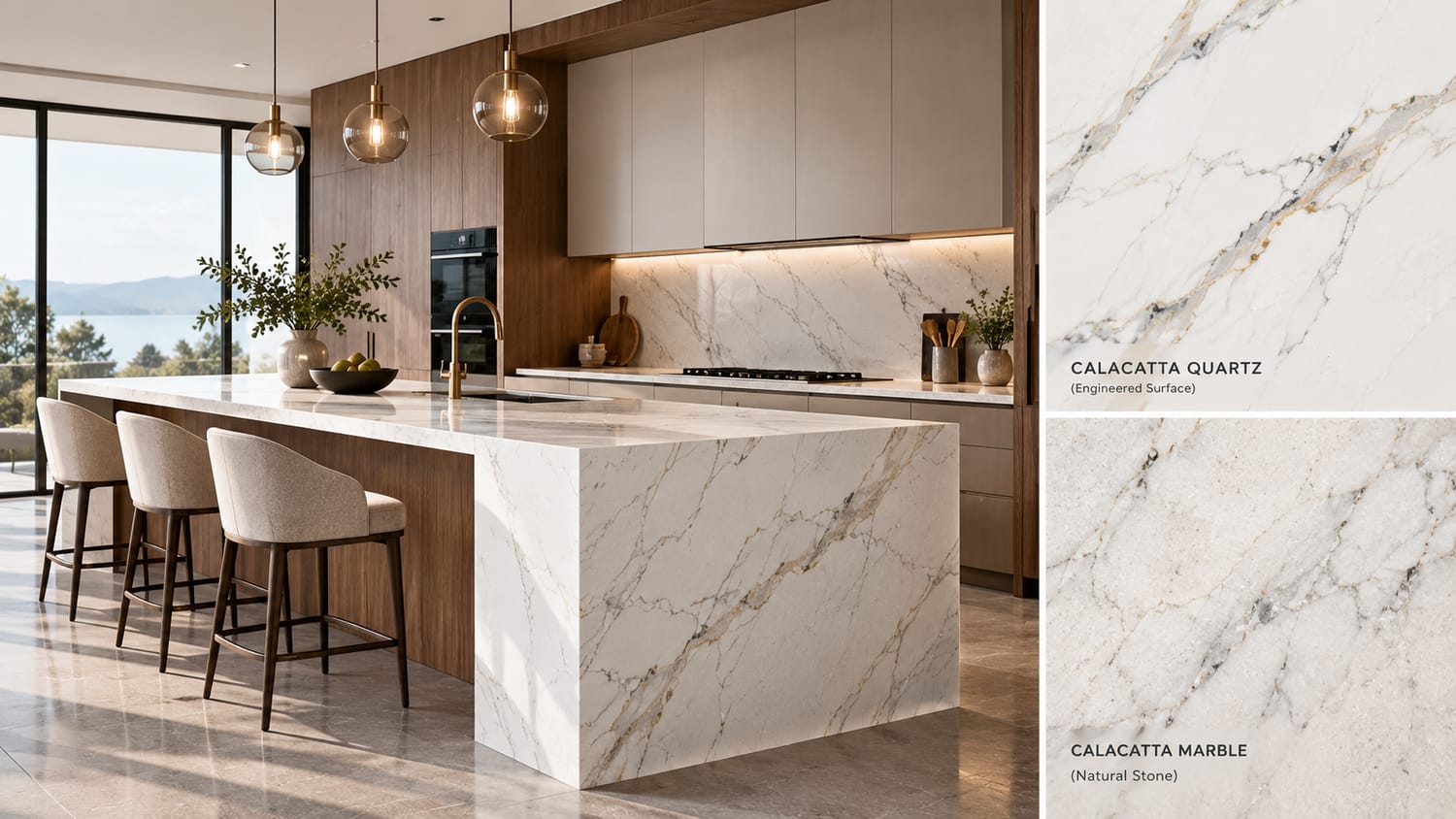
Calacatta Quartz vs. Calacatta Marble: What's the Difference?
Calacatta surfaces are admired for their elegant white backgrounds, dramatic veining and luxurious appearance. They have become a popular choice for modern kitchens, bathrooms, hospitality interiors and architectural projects. However, when selecting a Calacatta surface, buyers often face an important decision: Calacatta quartz or natural Calacatta marble?
Although both materials offer a similar visual appeal, they differ significantly in composition, maintenance, consistency and everyday performance.
For homeowners, architects, interior designers and project developers looking for the beauty of Calacatta designs with practical everyday functionality, Calacatta engineered quartz offers several important advantages.
In this guide, we explore the differences between Calacatta quartz and Calacatta marble and explain why engineered quartz is an excellent surface choice for contemporary interiors.
1. What Is Calacatta Quartz?
Calacatta quartz is an engineered surface designed to capture the distinctive appearance of Calacatta marble. It generally features a white or warm-white background with elegant grey, gold or beige-inspired veining.
Unlike natural marble, Calacatta quartz is manufactured using selected quartz aggregates, binding materials, pigments and controlled production processes. The manufacturing process allows designers and manufacturers to develop distinctive patterns and more controlled colour consistency.
Calacatta quartz combines the visual character of marble-inspired designs with the practical benefits of an engineered surface.
It is widely considered for:
- Kitchen countertops and islands
- Bathroom vanity tops
- Kitchen backsplashes
- Reception desks and office counters
- Hotel and hospitality interiors
- Decorative wall features
- Commercial and residential projects
Its combination of design flexibility and functional performance makes it an attractive option for projects where appearance and usability are equally important.
2. What Is Natural Calacatta Marble?
Calacatta marble is a natural stone traditionally associated with the Carrara region of Italy. It is recognised for its bright background and distinctive, dramatic veining, which may include grey, gold, cream and other natural tones.
Each block develops through geological processes over millions of years. Consequently, every marble slab has its own natural variations in colour, veins and patterns.
This uniqueness is one of the reasons natural Calacatta marble is valued in luxury architecture and interior design.
However, natural marble is a calcium-carbonate-based stone. It can react with acidic substances, absorb liquids and develop surface marks through everyday use. It also requires appropriate care and periodic sealing.
For buyers who appreciate authentic natural stone and its individual character, Calacatta marble remains a distinctive material. However, its maintenance requirements should be considered before specifying it for frequently used surfaces.
3. Calacatta Quartz vs. Calacatta Marble: Key Differences
Both materials offer an elegant appearance, but their practical characteristics are different.
| Feature | Calacatta Quartz | Calacatta Marble |
|---|---|---|
| Material | Engineered surface | Natural stone |
| Appearance | Designed marble-inspired patterns | Naturally formed veining |
| Pattern consistency | More controlled across production batches | Naturally varies between slabs |
| Porosity | Generally non-porous | Porous |
| Stain resistance | Generally offers good stain resistance | More susceptible to staining |
| Acid resistance | Generally resists everyday acid etching | Can etch from acidic substances |
| Sealing | Typically does not require sealing | Periodic sealing is recommended |
| Maintenance | Relatively easy routine care | Requires more careful maintenance |
| Design selection | Multiple controlled design options | Unique natural patterns |
| Applications | Residential and commercial interiors | Residential and selected architectural interiors |
The main advantage of Calacatta quartz is its ability to deliver a marble-inspired appearance with greater consistency and easier everyday maintenance. Natural marble, meanwhile, offers genuine geological variation.
4. Appearance and Design: Which Offers More Flexibility?
Appearance is often the first consideration when choosing between Calacatta quartz and Calacatta marble.
Natural Calacatta marble is valued for its unpredictable veining. Its patterns are formed naturally, creating individual slabs that cannot be reproduced exactly.
Calacatta quartz approaches the same design language through engineered patterns. Manufacturers can develop different combinations of white backgrounds, soft grey veins, bold grey movement and warm golden accents.
This gives architects and interior designers more control when selecting a surface that complements a project's colour palette and design direction.
Some popular Calacatta-inspired quartz design styles include:
- Calacatta Gold: White backgrounds with warm golden and grey veining.
- Calacatta White: Clean white surfaces with subtle grey movement.
- Bold Calacatta: Prominent veins for statement countertops and islands.
- Soft Veined Calacatta: Delicate patterns for minimal and contemporary interiors.
For larger installations, controlled pattern selection can also help designers plan countertops, islands and backsplashes more effectively.
5. Durability and Everyday Performance
One of the most important differences between engineered quartz and natural marble is how they perform during everyday use.
Calacatta quartz is designed for regular interior applications. Its engineered composition generally provides a dense, non-porous surface that resists common household stains and does not require periodic sealing.
Natural Calacatta marble is comparatively more sensitive to everyday kitchen substances. Liquids can penetrate the surface if it is not properly protected, while acidic products such as lemon juice, vinegar and wine can cause etching.
For frequently used kitchen countertops, these differences can influence the long-term appearance and maintenance requirements of the installation.
However, engineered quartz is not indestructible. Excessive heat, direct contact with very hot cookware, heavy impact and unsuitable cleaning chemicals can damage the surface. Using trivets, cutting boards and manufacturer-recommended cleaning methods is important.
For technical comparisons, see this guide to engineered quartz slabs.
6. Maintenance: Why Engineered Quartz Is a Practical Choice
Maintenance is an important consideration for busy households, hotels, restaurants and commercial spaces.
Natural marble generally requires more attention because it is vulnerable to staining and acid etching. Appropriate sealing and careful cleaning help protect its appearance, but they do not eliminate its sensitivity to acids.
Calacatta engineered quartz offers a simpler maintenance routine.
For regular cleaning:
- Wipe the surface with a soft cloth.
- Use mild soap and water for everyday cleaning.
- Avoid abrasive cleaning pads and harsh chemicals.
- Clean spills promptly.
- Use trivets for hot cookware.
- Follow the manufacturer's care and maintenance instructions.
Because engineered quartz is generally non-porous, it does not require the periodic sealing associated with natural marble.
This makes it a convenient option for kitchens, bathroom vanities and other regularly used interior surfaces.
7. Applications: Where Does Calacatta Quartz Work Best?
Calacatta quartz is particularly versatile in contemporary interior projects. Its marble-inspired appearance allows it to complement different architectural styles, while its practical characteristics make it suitable for a range of indoor applications.
Kitchen Countertops and Islands
Calacatta quartz is an excellent option for kitchen countertops, islands and breakfast counters. Its white background and expressive veining can create a refined focal point while offering convenient everyday maintenance.
Bathroom Vanity Tops
Bathroom vanities benefit from the clean and elegant appearance of Calacatta-inspired surfaces. Quartz can help create a coordinated look across vanity countertops and selected decorative elements.
Wall Features and Backsplashes
Large-format quartz slabs can be used for selected interior wall applications, backsplashes and decorative features. Their patterns can complement surrounding cabinetry, flooring and furniture.
Hotel and Hospitality Interiors
Hotels and hospitality projects often require surfaces that combine visual appeal with practical maintenance. Calacatta quartz can be considered for reception counters, guest bathrooms and selected interior features.
Commercial and Office Spaces
Reception desks, meeting areas and other interior counters can use Calacatta quartz to create a sophisticated and coordinated design language.
8. Why Architects and Project Buyers Prefer Calacatta Quartz
For architects, interior designers, fabricators and project buyers, material selection involves more than appearance. They also need to consider slab availability, dimensions, consistency, fabrication requirements and project timelines.
Calacatta quartz offers several advantages in this regard:
- Design consistency: Controlled patterns can simplify planning across multiple surfaces.
- Multiple design options: Different veining styles and background tones provide flexibility.
- Practical maintenance: The non-porous surface generally requires no sealing.
- Project suitability: Available slab dimensions and thicknesses can support a range of interior applications.
- Coordinated interiors: Matching design selections can help create a consistent visual direction.
For large projects, it is important to review actual slab samples, confirm batch availability and discuss fabrication requirements with the manufacturer before finalising specifications.
You can also explore our article on how to choose a quartz manufacturer in India.
9. Discover Premium Engineered Quartz Surfaces with Artizia
At Artizia, we believe that a premium surface should bring together design, manufacturing technology and quality-focused production.
From the house of Marudhar, Artizia offers engineered quartz surfaces developed using advanced Breton Stone Technology. Our collections feature contemporary colours, refined patterns and marble-inspired designs for residential, hospitality and commercial interiors.
Our Jumbo quartz slabs, commonly available in 3300 × 1650 mm formats, with 20 mm and 30 mm thickness options, provide design possibilities for a variety of architectural applications. Actual availability should be confirmed for the selected design.
Whether you are an architect specifying materials for a luxury residence, an interior designer developing a modern kitchen or a project buyer sourcing engineered quartz slabs, Artizia offers a collection designed to complement contemporary spaces.
Explore the Artizia engineered quartz collection to discover surfaces for your next project.
10. Frequently Asked Questions
Q1. Is Calacatta quartz the same as Calacatta marble?
No. Calacatta marble is a natural stone quarried from the earth, whereas Calacatta quartz is an engineered surface designed to reproduce its distinctive white background and dramatic veining.
Q2. Is Calacatta quartz better than marble for kitchen countertops?
For many frequently used kitchens, Calacatta quartz is a practical choice because it generally offers better stain resistance, does not require sealing and is less susceptible to acid etching than natural marble. The final choice depends on the desired appearance and care expectations.
Q3. Does Calacatta quartz require sealing?
Generally, no. Engineered quartz is typically non-porous and does not require the periodic sealing associated with natural marble. Always follow the specific manufacturer's care instructions.
Q4. Can Calacatta quartz be used for bathroom vanities?
Yes. Calacatta quartz is commonly considered for bathroom vanity tops because of its elegant appearance and relatively easy maintenance.
Q5. Does Calacatta quartz look like real marble?
Calacatta quartz is designed to recreate the visual characteristics of Calacatta marble, including white backgrounds and grey or golden veining. However, natural marble has unique geological patterns that engineered designs cannot reproduce exactly.
Q6. Is Calacatta quartz suitable for commercial projects?
Yes. It can be considered for selected commercial interior applications, including reception counters, hospitality spaces, office interiors and decorative surfaces, subject to the product's technical specifications and application requirements.
Conclusion
Calacatta quartz and Calacatta marble both bring an elegant visual character to interior spaces, but they offer different experiences.
Natural Calacatta marble appeals to buyers who value authentic natural stone and individual slab patterns. However, its porosity, maintenance requirements and sensitivity to acidic substances make it a more demanding option for frequently used surfaces.
Calacatta engineered quartz offers a compelling alternative for modern interiors. It combines marble-inspired aesthetics with controlled design patterns, easier maintenance and practical everyday performance.
For homeowners, architects, interior designers and project developers seeking a balance between visual appeal and functionality, Calacatta quartz is a surface worth considering.
Discover the engineered quartz collections at Artizia and explore possibilities for your next architectural project.