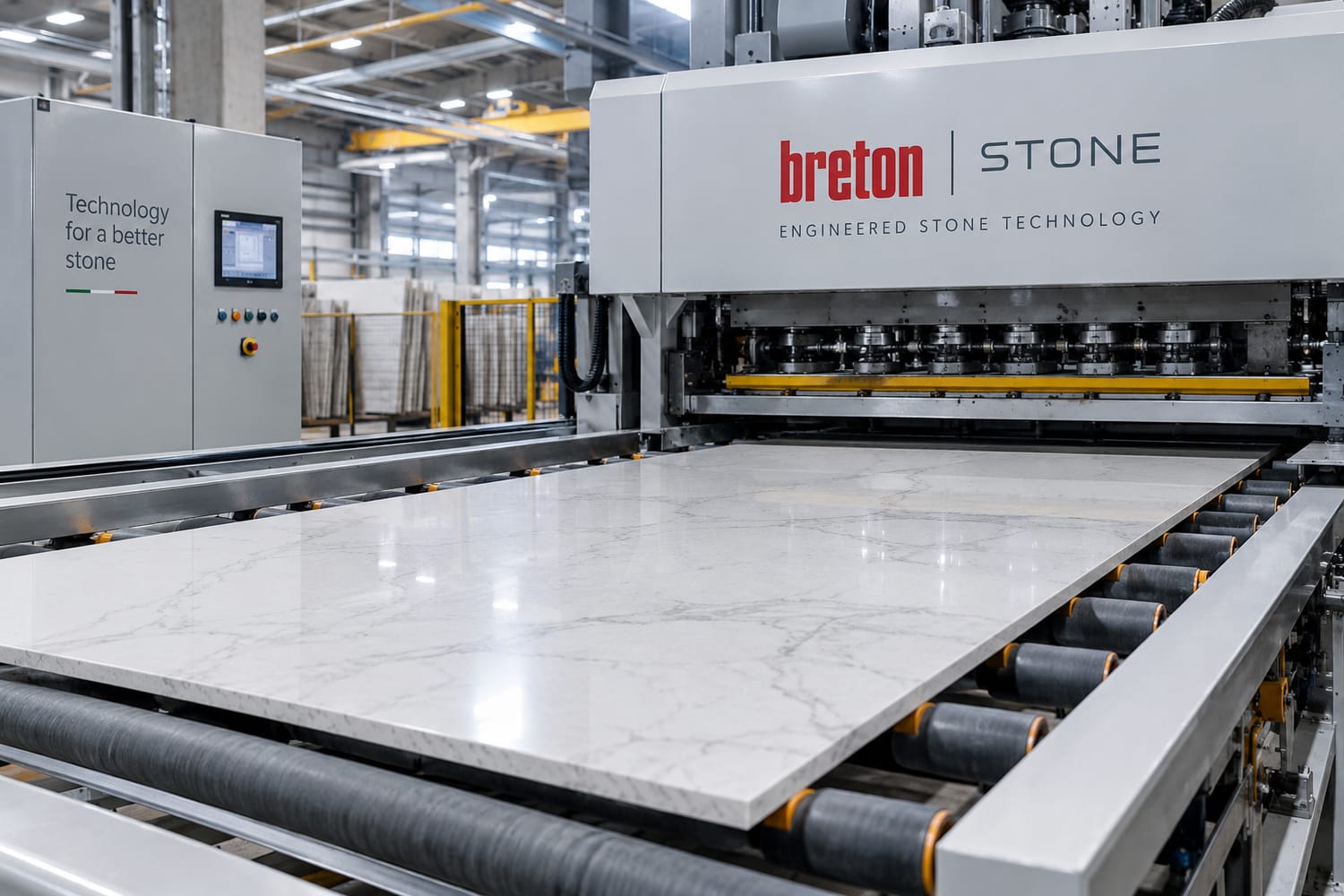
What Is Breton Stone Technology and Its Role in Quartz Manufacturing?
Introduction
The quality of an engineered quartz slab depends on several factors, including raw materials, manufacturing processes, surface finishing, and quality control. Among the technologies used in engineered stone production, Breton Stone technology has played an important role in shaping the modern quartz surface industry.
For manufacturers, architects, interior designers, and project developers, understanding this technology provides valuable insight into how engineered quartz slabs are produced and what to consider when selecting surfaces for residential and commercial projects.
At Artizia, advanced Breton Stone technology forms an important part of our engineered quartz manufacturing process. By combining manufacturing technology with contemporary designs and a quality-focused approach, Artizia creates quartz surfaces for kitchens, countertops, bathroom vanities, hospitality spaces, and architectural interiors.
What Is Breton Stone Technology?
Breton Stone technology, commonly associated with the BretonStone® system, was developed by Breton, an Italian company known for its industrial machinery and technologies for stone processing and engineered stone manufacturing.
The technology helped advance the production of engineered stone slabs by enabling manufacturers to combine selected stone aggregates with binding materials and pigments through a controlled industrial process.
Unlike natural stone slabs, which are extracted from quarries and cut into usable formats, engineered quartz slabs are manufactured by combining selected raw materials and processing them into a finished surface.
Breton Stone technology supports this process through specialised machinery and a manufacturing method that uses vacuum vibro-compression. This technique helps compact the prepared material into a dense, uniform slab before subsequent processing and finishing stages.
The result is a manufactured surface that can offer a controlled appearance, a wide variety of designs, and consistent slab dimensions when supported by appropriate production and quality-control practices.
How Does Breton Stone Technology Work in Quartz Manufacturing?
Understanding the manufacturing process helps explain why technology is important in producing engineered quartz slabs.
1. Raw Material Selection
The manufacturing process begins with selecting and preparing suitable raw materials. These typically include quartz aggregates, binding resins, and pigments, depending on the product formulation.
The characteristics of the selected materials influence the final slab's appearance and performance. Particle distribution, pigment selection, and formulation control are important considerations when developing different colours and patterns.
For premium quartz surfaces, careful raw material selection provides the foundation for the stages that follow.
2. Mixing and Colour Preparation
The selected ingredients are measured and mixed according to the required formulation. Pigments and design elements help create different colours, patterns, and visual effects.
This stage is particularly important for manufacturers producing collections that range from solid white and neutral shades to marble-inspired designs with distinctive veining.
Accurate formulation and controlled mixing help manufacturers work toward the intended appearance. The final result also depends on the production method, design configuration, and inspection procedures.
3. Vacuum Vibro-Compression
Vacuum vibro-compression is a central feature of Breton Stone technology.
During this stage, the prepared material is placed into a mould or production format and compacted using vibration and pressure under vacuum conditions. The process helps reduce trapped air and consolidate the material into a slab.
Effective compaction is important because the structure formed during manufacturing contributes to the slab's density, uniformity, and mechanical properties.
However, the final quality does not depend on machinery alone. Material formulation, process settings, equipment maintenance, and operator expertise also influence the outcome.
4. Curing and Slab Processing
After compaction, the slab proceeds through the appropriate curing or hardening process for its formulation. This allows the binding system to develop the properties required for subsequent manufacturing stages.
The slab can then undergo further processing, which may include calibration, grinding, and surface polishing or other finishing treatments.
These operations help bring the slab to the required thickness, surface appearance, and dimensional specifications.
5. Quality Inspection and Finishing
Before dispatch, finished slabs should be inspected against defined quality requirements. Depending on the manufacturer's procedures, checks may include dimensions, thickness, surface finish, colour consistency, visible defects, and flatness.
Quality inspection helps identify slabs that require further attention before they reach fabricators, distributors, or project buyers.
At Artizia, manufacturing combines Breton Stone technology with quality-focused inspection, finishing, and preparation for delivery. Each stage contributes to producing engineered quartz slabs intended for contemporary architectural applications.
Why Is Breton Stone Technology Important for Engineered Quartz?
The role of manufacturing technology extends beyond the production machinery itself. It influences how manufacturers manage the process and work toward repeatable product quality.
1. Consistency Across Slabs
Consistency matters when several slabs are required for the same kitchen, residential development, hotel, or commercial installation.
Controlled manufacturing processes can help manufacturers maintain more consistent dimensions, surface characteristics, and colour appearance. This is especially valuable for projects where multiple slabs must work together visually.
Actual consistency still depends on material selection, design complexity, production controls, and inspection.
2. A Wide Range of Design Possibilities
Engineered quartz manufacturing allows designers to explore colours and patterns that differ from those found in natural stone.
From clean whites and warm neutrals to dramatic marble-inspired veining, manufacturers can develop collections for different architectural styles.
Technology supports the production process, while design development and formulation determine the visual character of each collection.
3. Controlled Slab Dimensions
Manufacturing machinery is designed to produce slabs within specified formats and thickness ranges.
For architects, fabricators, and project developers, dimensional consistency can simplify material planning, cutting layouts, and installation preparation.
Artizia offers jumbo quartz slabs in a standard format of 3300 × 1650 mm, with 20 mm and 30 mm thickness options, subject to the availability of the selected design.
4. Performance Through Manufacturing Control
The performance of engineered quartz depends on the complete manufacturing system, including raw material quality, formulation, compaction, curing, and finishing.
Vacuum vibro-compression supports the consolidation of the prepared material, but it should not be treated as a guarantee of every performance characteristic.
Buyers should review the product's technical specifications, care instructions, warranty terms, and relevant test documentation when evaluating a quartz surface for a particular application.
How Does Breton Stone Technology Benefit Architects and Interior Designers?
Architects and interior designers need surfaces that complement their design vision while meeting project requirements. Manufacturing technology is one factor that helps them assess a product's suitability.
For kitchen countertops and islands, colour coordination, slab dimensions, fabrication requirements, and the appearance of the finished surface are important considerations.
For hotels, offices, hospitality environments, and large residential developments, repeatability and supply planning become especially relevant. Selecting suitable slab formats and confirming product availability early can help reduce avoidable complications during project execution.
Breton Stone technology is therefore relevant not only to manufacturers but also to professionals who specify, purchase, fabricate, and install engineered quartz surfaces.
Nevertheless, the correct slab should always be selected according to its documented properties and intended use. Fabrication and installation should follow the manufacturer's guidance.
Artizia: Engineered Quartz Surfaces Made with Breton Stone Technology
At Artizia, Breton Stone technology is an important part of our approach to engineered quartz manufacturing. Based at Mahindra World City, Jaipur, Rajasthan, Artizia brings together manufacturing experience, contemporary surface designs, and a focus on product quality.
Our collections include refined white and neutral tones, marble-inspired patterns, and statement designs created for modern interiors.
Artizia engineered quartz slabs are intended for a range of applications, including kitchen countertops, islands, bathroom vanities, dining tables, and selected commercial interiors, subject to the requirements of each application.
We recognise that architects, interior designers, fabricators, and project developers need more than an attractive design. They also need reliable product information, appropriate slab specifications, and support when planning their projects.
By combining manufacturing technology with design development, finishing, inspection, and project-focused service, Artizia aims to help professionals identify surfaces that suit their aesthetic and practical requirements.
To explore available designs, slab specifications, or sample options, visit the official Artizia website.
Frequently Asked Questions
1. What is Breton Stone technology?
Breton Stone technology is a system developed by Italian company Breton for engineered stone production. Its vacuum vibro-compression process helps compact prepared stone aggregates and binding materials into slabs.
2. Is Breton Stone technology used to manufacture engineered quartz?
Yes. BretonStone® technology is used in engineered stone production, including engineered quartz slab manufacturing. The finished product depends on the raw materials, formulation, production settings, curing, and finishing processes.
3. Does Breton Stone technology guarantee better quartz quality?
Technology can support controlled manufacturing and repeatability, but it does not independently guarantee the quality of every slab. Material selection, process control, equipment condition, finishing, and quality inspection are also important.
4. What should buyers check before choosing engineered quartz slabs?
Buyers should review slab dimensions, thickness, colour and pattern consistency, surface finish, technical specifications, maintenance instructions, warranty terms, and suitability for the intended application.
5. Where can I explore Artizia engineered quartz surfaces?
You can explore Artizia's engineered quartz collections, learn about the brand, and contact the team for product information or sample enquiries at https://artizia.co.in/.
Conclusion
Breton Stone technology has contributed significantly to the development of modern engineered stone manufacturing. Through vacuum vibro-compression and specialised production machinery, it supports the controlled formation of engineered stone slabs in a variety of formats and designs.
However, manufacturing technology is only one part of the equation. Raw material selection, formulation, curing, surface finishing, and quality inspection all contribute to the characteristics of the finished product.
For architects, designers, fabricators, and buyers, understanding these factors makes it easier to evaluate engineered quartz beyond its appearance alone.
At Artizia, Breton Stone technology is part of our commitment to manufacturing engineered quartz surfaces for contemporary residential, hospitality, and commercial interiors.